Saturday, July 1, 2017

Day Six: Water, Water, Everywhere

Today was a wet one for the crew of the Sigsbee.
We got off to an early start—even early by Sigsbee standards— and began the longest transit of the trip, seven hours from the Eastern Shore to the mainland.
During this time, students took care of the usual tasks the boat requires, nearly on their own. With very little help from professional crew, they can raise both sails, lower the centerboard, man the helm, and throw and tie off dock lines. During the science time, students did a multitude of things, and I'll let them speak for themselves.

Anya says, "My favorite part of the day —there's so many things—working on the project was really cool because we got to look at the things that have different effects on the bay. I was looking at the human impact and how something like global warming could impact the bay and its biodiversity."

Students also started work on bands that they're weaving themselves, making good use of their new knot skills.

One in progress and one finished.

DaRe'one told me that "we were learning about lift and velocity and how they're interchangeable. High pressure corresponds with low velocity and low pressure with high velocity. The boat uses lift to go along the waves, so to understand lift on the sail you have to understand pressure and velocity."

Sigsbee has been treating us well, so when we docked, it was time to return the favor to her. We broke out the sponges, brushes, and soap and gave her a good scrubbing.


Scrub a dub


Manning the hose.

Soon after, we headed to the beach. "We went fossil hunting on the beach and I got an imprinted fossil," says DaRe'one.


Unfortunately, we got rained out—hard. 


That provided its own entertainment, though: "It was fun to run back from the beach and work as a team to get camp set up right before the rain hit," says Anya.


Staying dry and entertained.


Good night for now, and check back soon!

Edit: I'm updating this just because I'm blown away by how into their projects these guys are. As I'm sitting here prepping for tomorrow, I've heard the educational coordinator get questions like, "What is the name of the equation used to calculate biodiversity?" and "What are some of the effects of pollution on jellyfish?" and What's the salinity level that oysters feed at?" It's nearly dark yet they're still hard at work by lantern light.


Day Five: Oysters

Pretty quick update about yesterday. The crew stayed at the same campsite last night, which means no sailing during the day. Instead, we toured the Horn Point Marine Lab. Specifically, we learned about their oyster restoration project.
Touring the lab.


We learned about the entire life cycle of oysters—from larvae to fully grown—and how beneficial to the environment of the Chesepeake they are. 
A few other facts we learned:
•Oysters can change gender.
•The Marine Lab distributed 1.78 billion spat into the Chesepeake last year, their largest amount ever.
•The more movement oysters go through, the harder their shells get, so scientists at the lab hang oysters in baskets that get jostled by the waves.
•A bucket of larvae can cost hundreds of thousands or millions of dollars—and would contain millions of larvae.
•They have an eyespot and a foot that looks like a tongue.
•They can only stick to something once—so if they miss an oyster bar, they can get buried in sand and suffocate.
•Each oyster can spawn millions more, though very few survive.
•Oysters eat plankton, phytopkankton, fats, and algae.

In exchange for the cool information on oysters and letting us camp at Horn Point for two nights, we put in a little elbow grease and helped them clean oysters and oyster tanks. I was working with Port Watch, so most of the pictures today are of them. Hoping to get more of The six crew members in Starboard Watch!

Cleaning, cleaning , cleaning

Back at camp, the evening was busy with showers (first proper ones in five days!) and a bit more laundry. We ended the night with tie dying some bandannas—which I didn't get a picture of, but each student has their bandanna to as a keepsake, dyed in Sigsbee colors (blue and white).

Now we're back on the boat and headed for our next destination, which is our longest transit of the trip: fully seven hours under sail. Watches are busy keeping the ship running or working on science projects as I type. 


Check back tonight or tomorrow morning for another update!

Okay, one more picture from yesterday:

Titanic poses at sunset.


Thursday, June 29, 2017

Day Four: Diving and Dredging

My contributor today was Wes, who said his favorite part of the day was swimming—since we got rained out a few days ago, it was highly anticipated by everyone.


Our captain taking a swim.

Jumping off the Bowsprit, or the very front of the ship.

"We got to jump off the skipjack," Wes told me. "I was asking to jump off this entire week and I finally got to. I landed on some jellyfish though." Not to worry though, Wes' parents: we had our first aid kit handy, and jellyfish don't hurt too much anyway. Meat tenderizer breaks down the jellyfish proteins and quickly neutralizes the stingers, and we had plenty on hand.

Off the back!

When they weren't at play, the cadets were learning more about the wildlife of Chesapeake Bay. Wes again: "I learned about birds— thedifferent parts and how they each can be used for identifyinging the bird and each have different characteristics that help them survive in their habitat." Students also dredged for oysters, collecting them from the bottom of the bay with a dredge. Dredging is what Sigsbee was built for, and she performed admirably.

Games back at the campsite.

Making dinner.

The night at camp was a pretty regular one—games and grilling—but we ended with a few surprises:

Dissecting squid! And using the ink sacs to write letters home.

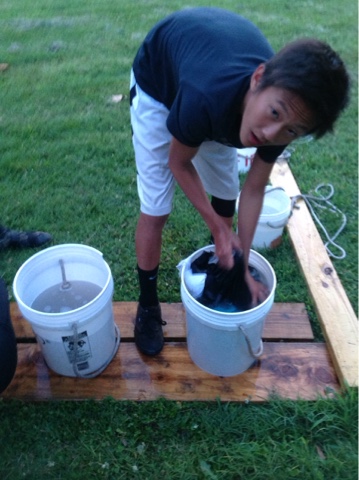
We finished the night with laundry, everyone's favorite chore.

And a final word from Wes: "Oyster dredging was pretty fun too because we found two fish and a bunch of crabs inside the oysters."


Good night from our beautiful campsite right on the water!

Wednesday, June 28, 2017

Day Three: Chesapeake History

After the early wake up call yesterday for crabbing, today started at a leisurely 6:00am. Student crew members got a taste of the "usual" routine (or a usual as our routines get on Sigsbee), and we got under way by 7:30. Students charted the course for the day, and by the afternoon we approached Tilghman Island, our stopping point for the day. 

Setting the day's course on the charts.

And following it!

Before docking, we ran out a net to catch some sea life. Hundreds of little jellies—properly called tinafores—were our only catch. All the same, he students identified which variety all of the, were, counted them, tested the water, and took a variety of other measurements to properly begin their experiments on the Chesepeake Bay ecology.

Tossing out the net.


One of our little jelly friends.


The day ended with a tour of the Tilghman Watermen's Museum, where we learned some of the island's history. "My favorite part was going to the museum," said Angel. "It was cool because I got to see old companies and some vintage stuff. It was from a time when everyone trusted each other."


We also visited Phillip's Wharf Evironmental Center, where we learned about some of the species of the Chesapeake bay, including turtles, sea horses, crabs, various fish, and oysters. Kelvin really enjoyed this part: "My favorite part of the day was seeing horseshoe crabs. I learned they've survived for 55 million years and I got to touch one!" 


The horseshoe crabs!

Tomorrow holds more exciting adventures, so check back soon!

Tuesday, June 27, 2017

Day Two: Crabbin'

Day two, and what an early morning it was! Half the crew was roused at 4:30am to go crabbing with an East Shore waterman, Clay Larramore. A couple hours of trotlining, then the other half of the crew took over with Clay while the first half tore down camp.
 Wranglin' some crabs.

Some true crabbers.

Today's catch.


Cameron contributed to the blog tonight. "Although the boat ride was early, I enjoyed it and I thought it was a good experience to learn about trot lining, he said.

Because of the crabbing, we got to a late start on Sigsbee and accordingly made a short hop back across the Chesapeake to tonight's campsite. During the trip, Port Watch was on deck duty—preparing the sails, steering the boat, coiling lines, and practicing knots—while Starboard Watch was on science duty. Cameron again, who was on science duty:

"We learned about estuaries, how many types there are, and what type the Chesapeake is. It's a partially mixed estuary, meaning it's brackish water which is some salt and some fresh water.
We also learned the neighboring states and what types of estuaries have."

Lunch aboard Sigsbee.

Upon arriving at our campsite, our swimming at the beach was cut short by a brief thunderstorm. All the same, we got a good kickball game in and made dinner, including our fresh-caught crabs.

Husking corn for dinner.

As I type, he night is ending around a campfire with s'mores, classic camping games, and some good old conversation. I'll leave Cameron with the last word:  "It was a good day! I liked swimming a lot."

S'MOOOOOORES


Day One: Cast off


With an air of excitement—and perhaps a little trepidation—the newest crew members of Sigsbee arrived this morning at the docks to cast off on an adventure! During today's voyage, we started learning the basics of running a sailing vessel like Sigsbee, including raising the sails, manning the wheel, and docking at out next destination. Along the way, we had some time for a buoyancy challenge in which cadets made their own tin foil boats and attempted to keep them afloat with added weight.

Upon arrival at our campsite, sailors split into their two watches: teams of six that will be working together for the rest of the trip as a cohesive unit. Tents were raised, tacos were cooked, and flags were designed before bedding down after a long day.

Hauling up the main sail.

Buoyancy test: how much weight can the aluminum foil boat hold?

Setting up camp.

Port Watch does the dishes after a delicious dinner.

Check back within the next few days for more updates!


Monday, June 26, 2017

Welcome to Summer 2017

And they are off!  After a quiet, but fun night on campus, the students were picked up by LCF staff after breakfast and headed down to meet the rest of the Sigsbee crew and get their adventure started.  After some orientation and safety discussions the student crew helped the professional crew get the boat off the dock and underway.  They will update this blog as they have time, but don't be surprised if it takes a day or two as they'll be so busy having fun, being safe and learning TONS!


Some quick dockside goal setting after packing the van.


Captain Nick showed the students the route they'd be following over the next 9 days.


Getting assignments for their first time helping to get the boat off the dock.


And away they go........